
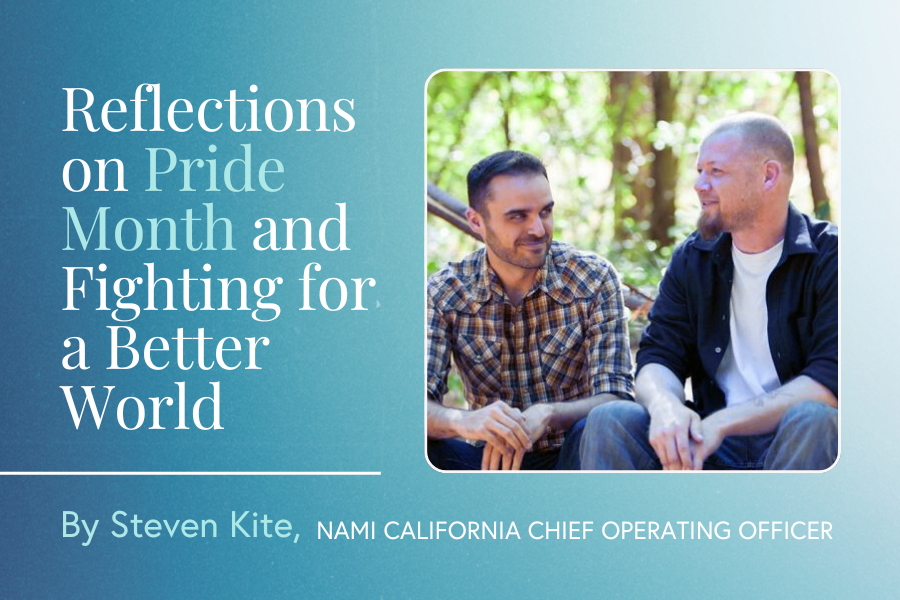
Post by NAMI California Chief Operating Officer Steven Kite
As we continue working to advocate for and support LGBTQ+ community members in their mental health journeys, our NAMI California team reflects on the ongoing movement and pressing need for justice and equity. These times remain increasingly challenging, but they also hold hope for meaningful change.
The LGBTQ+ community continues our fight for recognition and equity in a world that has not always felt we were worthy of that recognition. LGBTQ+ families have existed, of course, since the beginning of time, but in our modern understanding of what our community means in the context of the world, we have seen great triumphs and horrific tragedies. I want to share what it means to be part of this fight – not just as someone within the LGBTQ+ community, but also as an advocate for individuals living with mental illness and their families.
I use the word ‘fight’ intentionally – because Pride didn’t begin as a parade, it began as a riot.
The History of Pride
The recognition of Pride, and the rights of this community, started in the Stonewall uprising in the late 1960s, when heroes like Marsha P. Johnson, Sylvia Rivera, and Miss Major stood up with many other brave advocates to say the laws of this country would not define the rights that we have, nor would we be defined by the broader culture and society. We would define our own lives, our own families, and our own path to equity. They were brave enough to state that they would not be criminalized for being who they were.

Marsha P. Johnson and Sylvia Rivera at Pride March, 1989
Digital Transgender Archive
This fight is similar, in many ways, to the struggle for acceptance and dignity for individuals living with mental illness and their families. When laws didn’t recognize the challenges of these individuals, and treatment didn’t work, we at NAMI fought for a better world. We fought for families’ rights to live lives of dignity and respect, free from discrimination. Since our beginning we have discovered together that the struggle would be messy, beautiful, and emblematic of the best parts of ourselves and the world.
Mental Health Support and Access to Care
LGBTQ+ people have also had struggles with the medical industry, specifically psychiatry. Members of this community were labeled as having a mental illness and were sometimes hospitalized; the official diagnosis didn’t leave the Diagnostic and Statistical Manual of Mental Disorders (DSM) until as recently as 1987. In fact, there are many nations in the world, including our own, that create laws that discriminate actively against LGBTQ+ people. For these reasons, amongst many others, our community has had a very complicated relationship with the mental health field.
Not surprisingly, there are relevant and alarming statistics about LGBTQ+ people and mental health. According to The Trevor Project’s 2025 U.S. National Survey, 36% of LGBTQ+ young people seriously considered attempting suicide in the past year, including 40% of transgender and nonbinary young people. Concerningly, 44% of LGBTQ+ youth wanted mental health care in the past year couldn’t access it. Additionally, transgender and nonbinary young people who were unable to access the hormones they wanted were nearly twice as likely to attempt suicide than those who could. These statistics aren’t created in a vacuum. In 2025, GLAAD counted more than 930 anti-LGBTQ+ incidents from May 2024 through April 2025, 52% of which targeted transgender and gender nonconforming people, across 49 states and Washington, D.C. When people feel afraid, unaccepted, and hated, it severely impacts mental health.
90% of LGBTQ+ youth said their well-being was negatively impacted due to recent politics, anti-LGBTQ+ victimization, and rhetoric.
These numbers don’t just reflect a crisis – they reveal a system that continues to fall short for LGBTQ+ youth and a nation that mistreats and stigmatizes this community.
We are seeing corporations take steps back from pride month and protection and support of the LGBTQ+ community. We used to see so many brands change their logos and release pride collections, and while these actions may have been seen as insignificant, in recent years less are participating signaling a much more sinister, scary world for the LGBTQ+ community to navigate. Last year, Meta updated their guidelines to prohibit insults about someone’s intellect or mental illness, however with a caveat permitting users to say LGBTQ+ people are mentally ill. This climate of fear, rejection, and erasure is not just political – it’s deeply personal, and it’s hurting young people across the country.
It’s often said that LGBTQ+ people can be born into an “enemy camp,” meaning we may be isolated even within our own families. This situation can make it even harder to address and embrace the fullness of our identities. It can begin with youth feeling like they are not good enough or worthy of getting the support or care they deserve.
Fighting for a Better World
This fight is personal. It’s personal for our communities, for the families we serve, and for many of us doing this work.
For me, this meant that I began my journey in mental illness as an early consumer of psychiatric services. My struggle with anxiety began when I was a child. From an early age, I strove to prove myself and achieve.
I remember always finding the kids who were left out in elementary school and trying to help them feel included. As I look back, I realize that I saw clearly how our society doesn’t always take care of everyone, and how it is up to each of us to do what we can to build the world we want. I also recognize that in those smaller acts of kindness were likely rooted in my feeling different and longing for that same kindness shown to me.
Before I came to NAMI, I worked in the private sector and always felt like something was missing. Although I was building businesses to be more successful, it seemed empty to me, in many ways. I wasn’t working toward something that spoke to my values as a person, and I realized that I wanted my hard work to pay off – not for myself, but for the world.
These ideas combined into a role I had worked on to advocate for individuals, families and communities who may also feel left out. I wanted to find ways to bring them in. It is true that we are stronger together. This is true in our families, in our communities, and in our world. Starting out, I worked with young people who were in residential care facilities. From there, I moved on to a local organization in Sacramento that worked to directly serve individuals living with mental illness, breast cancer, and HIV/AIDS. We also held a youth group for LGBTQ+ people thinking about their identities and deciding about their futures.
It was after working at the city level when I started to think about how I could find ways to help more families, that I found NAMI California. Here at NAMI California, we fight every day for the rights of families and individuals to live lives of dignity and respect. We take our impact at the local level and build on that to impact the state and build on that to impact the nation. We disrupt the status quo when the status quo doesn’t tell the stories of our families.
NAMI California has a history of disruption. From our members sleeping in the Governor’s office to fight early on for the rights of our families to the passage of Prop 63 (the Mental Health Services Act), to the thousands of letters that have been sent to preserve the family voice in behavioral health planning in the 2026 state budget, NAMI California has been a leader in changing the status quo, led by members demanding changes for our families. Our success has come from disruptive actions; our fights for justice are intertwined and inseparable. We will continue to stand together, and in the end, we will all find a better place.
We can all learn from our LGBTQ+ community members at Pride celebrations, where we gather to celebrate our progress. We invite everyone and march ahead knowing we still have work to do. We remember the classic saying: “None of us are free until all of us are free.” Our struggles in mental health are really all the same struggles. We fight for the ability to live our lives with all the potential we were endowed with at birth, and to move our communities to a place of greater kindness, acknowledging the pain of the past, and having a vision of the world we want for all of us.
So, let’s move forward, in purpose. Let’s keep building on our impact toward the tomorrow we know we will reach